Stop Getting Bad AI Answers: The RECIPE Framework for Better Prompts
If you want to know how to get better AI answers – not just okay ones, but genuinely useful ones that feel like they were written just for you — this is the post for you.
Because here’s what most people type into AI:
“Write me something about healthy eating.”
And then they say AI doesn’t work. But AI works just fine. The problem isn’t the tool. The problem is the prompt.
Today I’m going to teach you a framework that fixes that. I call it RECIPE.
The Blank Box Problem
Here’s what happens to almost everyone when they first try AI.
You open the tool, you see that empty text box, and you freeze. What am I supposed to type? How do I ask it the right way? What if I do it wrong?
I call this the blank box problem. It’s the number one reason people try AI once and never come back.
There’s no wrong way to use AI — you can type anything. But there is a better way. And once you learn it, the difference in your results is night and day.
That’s what the RECIPE framework is for. A repeatable pattern you can use every single time, so you never have to stare at that blank box wondering what to say.
The RECIPE Framework – Six Letters, Six Ingredients
Just like a recipe in your kitchen, these are the six ingredients that make a great prompt. Put them together and you get results that feel completely different from anything you’ve gotten before.
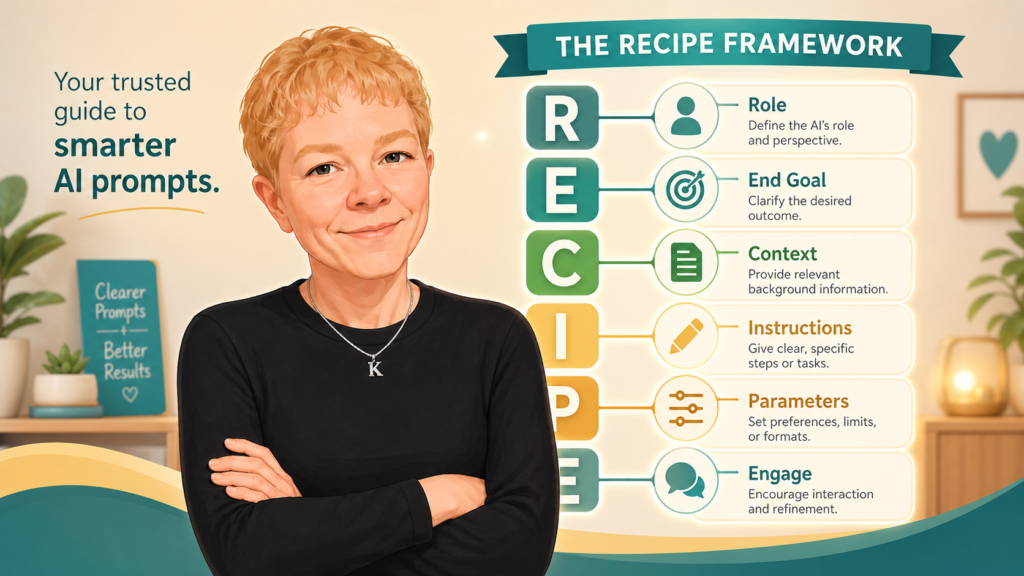
R — E — C — I — P — E.
Let’s go through each one.
R Is for Role
This is where you tell AI who to be.
“Act as a patient health educator.”
“You are a travel planner who specializes in trips for people over 60.”
“Be a writing coach who’s warm and encouraging.”
Why does this matter? Because when you give AI a role, it changes how it responds. A health educator gives you different information than a doctor, which gives you different information than a friend. The role sets the tone for everything that follows.
If I say “act as a nutritionist who works with people over 60,” suddenly the AI is thinking about my age, my stage of life, and the health concerns that are relevant to me. It narrows the focus in exactly the right way.
E Is for End Goal
What do you actually want to walk away with?
“I want a one-week meal plan.”
“I want three versions of an email to my landlord.”
“I want a list of questions to bring to my next doctor’s appointment.”
Be specific. Don’t say “help me with my healthy eating.” Say “give me a seven-day dinner plan for one person who doesn’t eat fish and wants to keep each meal under 30 minutes.”
The clearer your end goal, the more useful the response. Every time.
C Is for Context – The Magic Ingredient
This is the one that changes everything. Context is the background information about you, your situation, and what matters to you. It’s what makes AI’s response actually relevant to your life instead of a generic answer for everyone.
“I’m 65, I live alone, I have joint pain that makes standing for long periods hard, and I’m trying to eat healthier after my doctor told me my cholesterol is high.”
That one sentence of context completely transforms the response you get. Without it, AI gives you something generic. With it, AI gives you something that feels like it was written just for you.
Here’s something I say often and mean completely: the gap between bad AI results and great AI results is context, not the tool. Context engineering is the most important skill you can learn. We touched on it in the first AI chat video — this is where it really comes into its own.
I Is for Instructions
This is where you tell AI how to do the thing.
“Break it into steps.”
“Use simple language.”
“Give me options, not just one answer.”
“Start with the easiest option first.”
“Explain each step like I’ve never done this before.”
Think of it this way: Role is the who. End goal is the what. Context is the why. Instructions are the how.
The more specific you are here, the less editing you’ll have to do later. It’s like giving directions to someone who’s never been to your house. The more detail you give, the more likely they are to actually get there.
P Is for Parameters
Parameters are the guardrails. The constraints. The things that keep the response from going off the rails.
“Keep it under 200 words.”
“Use a warm, conversational tone.”
“Don’t use any medical jargon.”
“Write it at a level a ten-year-old could understand.”
“No bullet points, just paragraphs.”
Parameters tell AI what not to do and how to stay within bounds. Without them, you might get a 2,000-word essay when you wanted a paragraph, or something that sounds like a medical textbook when you wanted plain English.
This one is especially important if you, like me, don’t want jargon. Just say so. AI will match your parameters when you tell it what they are.
E Is for Engage – My Favorite Ingredient
Instead of trying to think of everything up front, instead of stressing over whether you covered all the details, you just add this one line at the end:
“Ask me a few questions to make sure you understand what I need.”
That’s it. You let AI interview you.
What happens next is so, so, so good. The AI will ask you things you didn’t even think of. “What tone are you going for?” “Is this for a specific person or a general audience?” “Do you have a word count in mind?”
It takes all the pressure off. You don’t have to write the perfect prompt. You just have to start the conversation and let AI help you fill in the gaps.
This is especially powerful if the number one thing stopping you is “I don’t know what to type.” With Engage, you don’t have to know everything. You just say: “Before you do this, ask me some questions first.” And AI does the rest.
See It in Action – The Full RECIPE, Built from Scratch
Let me show you the difference between a basic prompt and a RECIPE prompt.
Most people would type: “Write a letter to a friend.”
It’s fine. But it’s generic. It could be for anyone.
Here’s the same request built with RECIPE:
—
Role: You’re a warm, thoughtful writing assistant who helps people express themselves naturally.
End goal: I want a heartfelt letter to a friend I haven’t spoken to in about two years.
Context: Her name is Linda. We were close in our 40s, but life got busy. She’s been on my mind since her husband passed away six months ago. I want to reconnect without making it awkward or heavy. I’m not good at this kind of thing and I tend to overthink it.
Instructions: Start with something light – not “I’m sorry for your loss” right away. Acknowledge what happened, but keep the overall tone warm and forward-looking, with a real invitation to get together.
Parameters: Keep it under 250 words. Conversational tone. No clichés.
Engage: Before you write this, ask me three questions to make sure you really understand what I’m going for.
—
Same AI tool. Same technology. But the prompt changed everything.
And because I used Engage, the AI asked me things I hadn’t even thought about. The result was better than I would have gotten even with a really detailed prompt. That’s RECIPE.
You Don’t Have to Use Every Ingredient Every Time
Sometimes a quick question is all you need. RECIPE is for when you want something really good — when you want AI to give you something that feels like it was made just for you.
But start with the whole thing at least once. Pick something real in your life that you want help with. Open your AI tool. Build a RECIPE prompt.
I promise you the result is going to be different from anything you’ve gotten before.
Role. End goal. Context. Instructions. Parameters. Engage.
That’s the RECIPE.
In the next video, I’m sharing 15 things you probably didn’t know you could ask AI – real life uses, not business stuff. If you’ve been wondering what to actually do with this tool day to day, that one’s for you.
→ Watch it here: [LINK TO VIDEO 6 BLOG POST when published]
Alright, my friends. Take care. Bye bye.
About Kris Voelker: Kris is the founder of Second Act with AI and the creator of the RECIPE Framework for AI prompt writing. She teaches AI tools and digital literacy to people over 60 at secondactwithai.com.