AI Explained Simply: What It Actually Is (And What Everyone Gets Wrong)
If you want AI explained simply – no jargon, no scary robot talk, just plain English – you’re in the right place.
Because here’s what most people think when they hear “artificial intelligence”: Terminator. Robots. Machines taking over the world. Or at the very least, something that’s going to make them feel stupid.
None of that is what you’re actually going to be using. Let’s clear this up once and for all.
Let’s Get the Scary Stuff Out of the Way First
When most people hear AI, they picture one of two things. Either it’s the Terminator situation – robots becoming smarter than us and taking over – or it’s the job-stealing situation – machines replacing humans and making us all obsolete.
I’m not going to pretend AI isn’t powerful. It is. I’ve compared its impact to COVID, not to scare anyone, but because I think it’s that significant. It’s going to touch every part of our lives.
But the AI you’re going to be using? It’s not a robot. It’s not taking over the world. It’s not replacing you.
It’s a conversation.
So What Is AI, Actually? Here’s the Simplest Way I Can Explain It (AI Explained Simply)
AI is software that has been trained on a massive amount of text – books, articles, websites, conversations – basically a huge chunk of human knowledge. And because it’s absorbed all of that, it can understand your questions and respond in a way that sounds like a real person.
It’s not alive. It’s not thinking the way you and I think. It’s not conscious.
But it is incredibly good at understanding what you’re asking and giving you useful, thoughtful responses.
Here’s the analogy I use: imagine you had a really well-read friend. Someone who has read thousands of books, studied every subject, remembers everything, and is endlessly patient. You could call this friend any time, day or night, and ask them anything.
How do I write a thank you note? What should I cook for dinner if I only have chicken and rice? Can you explain what my doctor just told me in words I can actually understand?
That’s AI. That’s what you’re going to be using. A really smart, really patient friend who’s available whenever you need them.
AI Is Not Google – and This Difference Changes Everything
This is so, so important, and it’s the thing most people miss.
Google gives you a list of links. Ten blue links. And then you have to figure out which one to click, which website to trust, and where to find the actual answer buried in a page full of ads.
AI gives you the answer. In plain English. In a conversation.
You ask. It responds. You ask a follow-up. It responds again. It’s a back and forth, not a search.
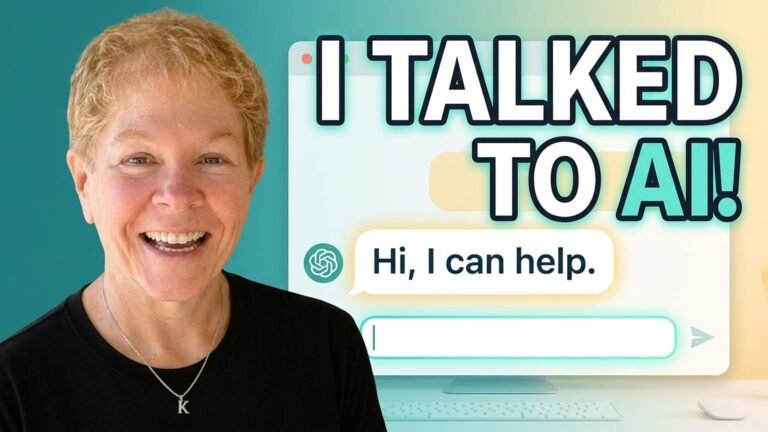
And what does it look like on your screen? A text box. That’s it. No complicated buttons, no confusing interface. Just a place to type.
In the video above, I type this prompt live: “I’m 62 years old and I just started learning about AI. Can you explain what you are in the simplest possible terms?” And it responds in real sentences that make complete sense. No clicking through ten websites. No digging for the answer.
That’s it. That’s AI. Not scary. Not complicated. Just a conversation.
What AI Can Do – and What It Can’t (Honest Answer)
I don’t do hype on this channel, so let’s be straight about both sides.
What AI can do is a lot. It can write. It can research. It can brainstorm ideas. It can explain things in plain English. It can help you organize your thoughts, plan trips, understand health information, create images, and help you build things you never thought were possible.
What AI can’t do is just as important to know.
It can’t feel. It can’t love. It can’t replace your judgment, your intuition, or your lived experience. It doesn’t know you the way you know you. It sometimes gets things wrong – and it can sound completely confident even when it’s incorrect. And it has no soul.
That last part matters to me. I believe in intuition. I believe in discernment. I believe in body, spirit, and soul. And I believe technology should serve those things, not replace them.
So the way I use AI – and the way I’m going to teach you to use it – is as a partner. A really capable partner. But you are always the one in charge. You are always the final eyes on everything.
Think of it this way: AI is an exoskeleton. You’re the human inside it.
Your Next Step
Now you know what AI actually is. It’s a conversation with a really smart, really patient tool that’s available whenever you need it. Not a robot. Not a threat. A tool.
In the next video, I walk you through your very first AI conversation — step by step, on my screen. I’ll show you exactly what to type, what happens when you hit enter, and how to keep the conversation going. If you’ve never opened ChatGPT or Claude or any of those tools, that video is going to change that. And it takes about ten minutes.
→ Watch it here
And before you jump in, take two minutes to find out which AI tool is the right fit for you. I built a free quiz for exactly this.
→ Take the AI Tool Navigator quiz
Alright, my friends. Take care. Bye bye.
About Kris Voelker: Kris is the founder of Second Act with AI and the creator of the RECIPE Framework for AI prompt writing. She teaches AI tools and digital literacy to people over 60 at secondactwithai.com.